| ID |
172 |
| Title |
The Silent Epidemic |
| Broadcast |
2013-02-12 00:00:00 |
| Network |
BBC World Service |
| Presenter |
Mark Whitaker |
| Producer |
Mike Hally |
| Precis |
Mark Whitaker reports from Bangladesh and Vietnam on the surprising fact that drowning is a leading cause of child death across SE Asia, and on the efforts being made to prevent it. |
| Duration |
23 |
| Txtime |
1899-12-30 08:00:00 |
| Repeat |
|
| Rpttime |
|
| Description |
Everybody assumes that the biggest killers of children in poor countries are diseases like cholera, pneumonia and dysentery and it's the belief that still drives the global public health agenda. Yet it's not actually true -- in countries like Bangladesh drowning is the number one killer and it's a leading cause of death across south-east Asia. That's a quarter of a million child fatalities every year - as many as all the children and adults who drowned in the Asian tsunami of 2004. Yet because most child drownings go unrecorded and because they happen in ones and twos every day, rather than in one great cataclysmic event, the problem has gone largely un-reported. It's a hidden killer -- a 'silent epidemic'.
Mark Whitaker reports from Bangladesh, and also from Vietnam - where the problem was identified with the help of the first US Ambassador to the country after the war, Pete Peterson. An ex-fighter pilot who spent 6 years as a POW in Hanoi, Peterson founded The Alliance for Safe Children which led the research that revealed the problem, and now leads a large drowning prevention programme.
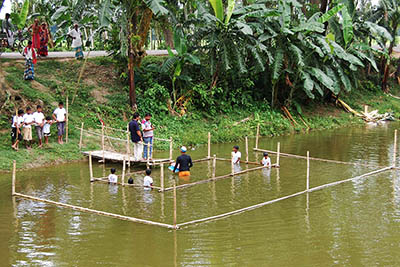
Children drown in these countries because there are so many ponds, irrigation ditches and rivers, often within yards of each house. Few know how to swim and the youngest are particularly vulnerable when mothers are too busy to supervise them closely. So in Bangladesh, a country much of which is under water, TASC is pioneering a huge programme of "survival swimming", training local instructors to teach simple swimming strokes, treading water and safe rescue. For children under 4 there's a parallel programme of village creches to keep them safe while their mothers do the chores.
Web links: The Alliance for Safe Children - you can assist their work by donating through the website
The Centre for Injury Prevention and Research Bangladesh
The International Drowning Research Centre
The Royal Life Saving Society Australia
The International Life Saving Federation
UNICEF
The World Health Organisation
|
| SqDogNumber |
56 |
| Pic1 |
 |
| Caption1 |
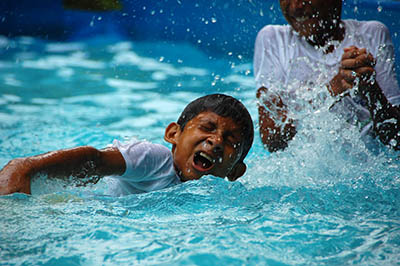
boy swimming in portable pool |
| Pic2 |
 |
| Caption2 |
village pond in rural Bangladesh, showing use of locally made bamboo compound to keep the swimmers safe |
| Pic3 |
 |
| Caption3 |
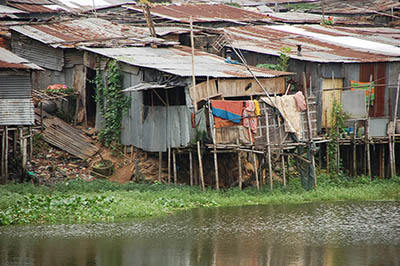
shanties on the edge of a deep lake in a poor area of Dhaka city - serious drowning hazard |
| Pic4 |
 |
| Caption4 |
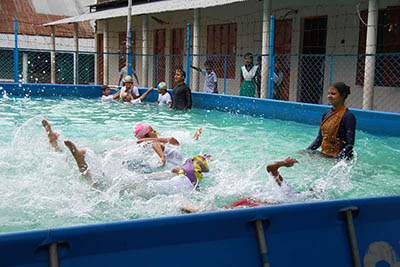
children learning to swim in a portable pool at a school in Dhaka |
| Pic5 |
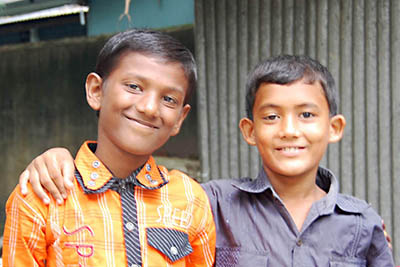 |
| Caption5 |
a 'Swimsafe' success - the boy on the left saved his younger cousin from drowning by using a stick instead of jumping in after him |