| ID | 150 |
| Title | Geo-engineering the Climate |
| Broadcast | 2010-03-10 00:00:00 |
| Network | Radio 4 |
| Presenter | Mark Whitaker |
| Producer | Mike Hally |
| Precis | Following December's climate conference in Copenhagen the world is now committed to holding global warming to a maximum of 2 degrees centigrade -- in theory. But without a binding treaty to curb carbon emissions, there's growing interest in "geoengineering" as a kind of insurance policy against the possibility that the worst predictions of some climate scientists come true. Mark Whitaker reports on research in key centres in Britain and the USA into ways of removing carbon dioxide from the atmosphere or reducing the amount of sunlight reaching the earth -- and on the massive technical, financial and political hurdles they face. |
| Duration | 28 |
| Txtime | 1899-12-30 21:00:00 |
| Repeat | |
| Rpttime | |
| Description | Following December's climate conference in Copenhagen the world is now committed to holding global warming to a maximum of 2 degrees centigrade -- in theory. But without a binding treaty to curb carbon emissions, there's growing interest in "geoengineering" as a kind of insurance policy against the possibility that the worst predictions of some climate scientists come true. Mark Whitaker reports on research in key centres in Britain and the USA into ways of removing carbon dioxide from the atmosphere or reducing the amount of sunlight reaching the earth -- and on the massive technical, financial and political hurdles they face. Last September the Royal Society concluded in a major study that while "early and effective action to reduce emissions of greenhouse gases" was preferable, geoengineering could be useful in addition and "should be subject to more detailed research and analysis." In this programme Whitaker visits some of the major US institutions, including NASA, that are now looking seriously at these techniques and sees some of the research already underway at places like Columbia University in New York, and the Woods Hole Oceanographic Institute in Cape Cod. And we hear from key scientists in the UK including John Shepherd, who chaired the Royal Society study, Stephen Salter, who proposes a fleet of remote-controlled cloud-brightening ships roaming the oceans, and Tim Lenton, who produced the first comprehensive assessment of geoengineering. Some of the proposals sound like science-fiction: launching giant mirrors into space, or pumping sulphur particles through an 18-mile high hose into the stratosphere, to mimic the cooling effect of volcanic eruptions. But even more mundane ideas, such as 'fertilising' the oceans so they absorb more carbon dioxide, involve enormous cost, effort and risk. The climatic consequences can't be accurately predicted, so some countries may be damaged; rainfall patterns will be changed, but no one knows exactly how; and so on. And it's not just a matter of science, technology and finance. The programme also examines the political and legal complexities that may be an even greater challenge. Geoengineering must be a global strategy, therefore it needs an authoritative global agency to oversee it, but will the UN be up to the job and would states like the US and China accept international restraints ? What about 'rogue' projects undertaken in defiance of agreed guidelines? And who will be liable for any problems caused? What kind of legal conflicts, or worse, could result from one country's "geoengineering" adversely affecting another? Above all perhaps -- if the world's nations can't agree effective action to curb carbon emissions, what prospect is there of them making geoengineering work even if it does prove technically feasible? A major concern among those who believe global warming is happening is that the prospect of a 'technological fix', however uncertain, will be taken as a green light to keep pumping out greenhouse gases. |
| SqDogNumber | |
| Pic1 | ![]() |
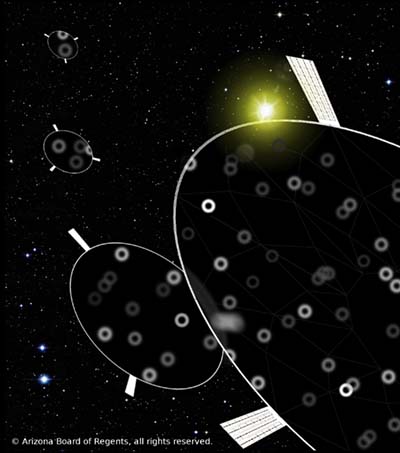
| Caption1 | One of the methods described in the programme -- Roger Angel's idea for 16 trillion small spacecraft positioned at the 'L1' point where an orbiting body is always lined up between the earth and the sun. The graphic shows the 2 foot-diameter flyers at L1. They are transparent, but blur out transmitted light into a donut, as shown for the background stars. The transmitted sunlight is also spread out, so it misses the Earth. This way of removing the light avoids radiation pressure, which would otherwise degrade the L1 orbit. (Roger Angel/Tom Connors/Johanan L.Codona, The University of Arizona) |
| Pic2 | |
| Caption2 | Picture to follow -- Artist's impression of Stephen Salter's design for a 'cloud-brightening' ship. Rotating columns work the same as sails. Underwater turbines generate power. Seawater sprayed up through the columns forces salt particles up into the clouds where they form millions of extra droplets, making the clouds more reflective. |
| Pic3 | |
| Caption3 | |
| Pic4 | |
| Caption4 | |
| Pic5 | |
| Caption5 |